



November 23, 2026
UMW
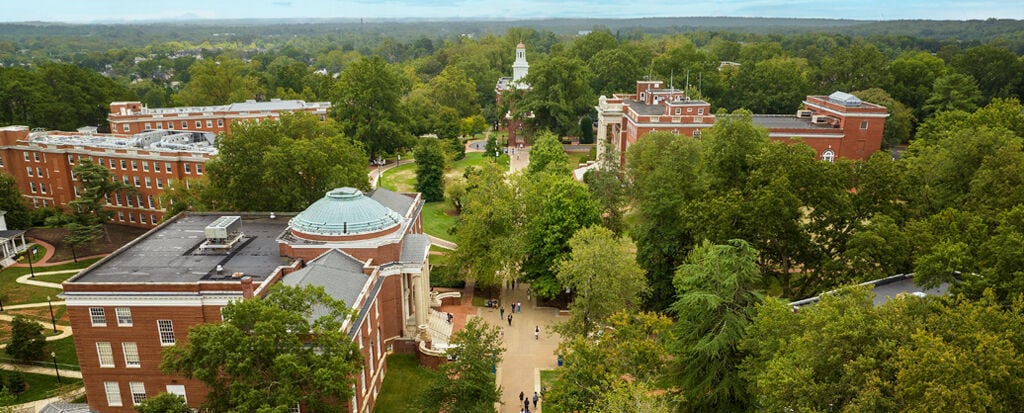
The University of Mary Washington has long been a hub for interdisciplinary teaching, public engagement and career preparation across the liberal arts and sciences. Now, through three newly established schools within the College of Arts and Sciences, UMW is strengthening the academic communities at the University’s core, creating new opportunities for faculty leadership, collaborative learning and connections across traditional disciplinary boundaries.
The three schools, all approved by the State Council of Higher Education for Virginia within the past two years, are the School of the Arts, led by Director Gregg Stull, professor of theatre; the School of Humanities and Social Sciences, led by Director Laura Mentore, professor of anthropology; and the Irene Piscopo Rodgers School of Science, led by Director Lynn Lewis, professor of biology.
People are also reading…
“The schools in the College of Arts and Sciences make visible the strengths of UMW’s programs, forge connections among them and give students and alumni larger academic communities throughout their time on campus and their lives after Mary Washington,” said Keith Mellinger, dean of UMW’s College of Arts and Sciences.
Each school brings together related programs and areas of study to strengthen academic pathways, support focused initiatives and enhance collaboration. The structure reflects a renewed commitment to UMW’s liberal arts mission while advancing the University’s Strategic Action Plan and its call to revolutionize the liberal arts for a rapidly changing world. More specifically, it will help faculty and department chairs develop programs and opportunities and give students an expanded ability to span fields and career paths.
School of the Arts
In the School of the Arts, learning is distinctly hands-on. The school brings together art, historic preservation, music, theatre and dance, along with the University’s museums and galleries, creating a community where making, performing, interpreting and preserving are all part of a liberal arts education. Students can pursue their own artistic discipline while exploring ideas and experiences beyond it, learning from faculty who are practicing artists, scholars and professionals and participating in the cultural life of the University and the Fredericksburg region.
Most recently the School of the Arts added a Bachelor of Fine Arts (BFA) in Performing Arts. The BFA combines intensive studio instruction with hands-on production experience while maintaining a liberal arts and sciences foundation. UMW is currently recruiting students interested in joining the program for the 2026-27 academic year.
School of Humanities and Social Sciences
The School of Humanities and Social Sciences brings together eight departments that share a common interest in understanding and improving the human condition. Whether studying our ancient origins, diverse cultures and languages, or global challenges like AI, mental health, and climate change, the humanities and social sciences take students from big ideas to practical application.
Areas of study include anthropology, art history, classics, philosophy and religious studies; communication and digital studies; English and linguistics; geography; history, American studies and sociology; modern languages and literatures; political science and international affairs; and psychological science. Across these fields, students develop both specialized knowledge and durable human skills, including critical thinking, ethical reasoning, communication, and how to examine evidence with care.
The school’s programs form a vibrant intellectual community where students hear from visiting speakers, conduct advanced research, and present their work to audiences on campus and beyond.
“The humanities and social sciences are the heart of the liberal arts at Mary Washington, touching nearly every student through their major or general education courses,” said Mentore. “Our faculty excel at teaching students how to grapple with enduring questions about humanity while also developing skills that are high in demand. I’m thrilled to support that work, and to leverage this new school to grow internships, community partnerships, and connections with our alumni in ways we never could before,” said Mentore.
Irene Piscopo Rodgers School of Science
The Irene Piscopo Rodgers School of Science is dedicated to delivering an exceptional undergraduate science education – one that combines rigorous academics, meaningful research, and the breadth of a liberal arts tradition. Here, undergraduates don’t wait until graduate school to carry out authentic science – they do it now. Coursework is shaped by student interests, so the content knowledge, lab skills and research habits they build here propel their careers. Biologists, chemists, physicists and earth and environmental scientists work side by side in a community where students learn by doing: conducting experiments, gathering and analyzing data, and asking hard questions about the meaning of their results. Fueling this momentum is the extraordinary estate gift of Irene Piscopo Rodgers ’59, whose belief in undergraduate scientists has opened doors to scholarships, research opportunities and programs designed specifically for students at the start of their scientific journey.
“Science doesn’t happen in a silo, and a liberal arts education makes sure our students don’t learn it in one. Our programs teach them to connect ideas across disciplines, both inside and outside the sciences, to ask big questions, and to explain why their work matters to the world beyond UMW,” said Lewis.
Across all three schools, students can connect their interests with faculty mentors and peers, building an academic and professional network before graduation. For alumni, the school names may be new, but the academic communities they bring together are deeply familiar. The professors, programs and disciplines that shaped generations of Mary Washington graduates now have new opportunities to connect across fields, engage alumni and students and build on UMW’s distinctive liberal arts and sciences tradition. The schools also give alumni a broader way to support student learning, research, creative work and emerging initiatives across related areas, extending the impact of their gifts and talents well beyond a single program.


